English
 Deutsch
 Espanol
 Français
 Portuguese
 中文
中文 한국어
한국어 日本語
日本語
PeopleSoft
What is PeopleSoft?
PeopleSoft is a software suite from Oracle that provides applications designed to help manage human resources, finance, supply chain, and customer relationship management (CRM) processes. The software is known for its flexibility, scalability, and ability to handle complex organizational structures.
What are the Key PeopleSoft Modules?
PeopleSoft offers a wide range of modules that cover various aspects of enterprise resource planning (ERP) and business management. A few of the key modules include:
- Human Capital Management (HCM): This module manages all aspects of human resources, including employee data management, payroll processing, benefits administration, talent acquisition, performance management, training and development, workforce planning, and succession planning.
- Financial Management: The financial management module handles core financial processes such as general ledger, accounts payable, accounts receivable, cash management, asset management, budgeting, and financial reporting.
- Supply Chain Management (SCM): The SCM module encompasses various functions related to supply chain operations. It includes modules for procurement, inventory management, order management, supplier relationship management, strategic sourcing, and demand forecasting.
- Customer Relationship Management (CRM): The CRM module focuses on managing customer interactions and improving customer relationships. It includes modules for sales automation, marketing campaigns, customer service and support, contact management, and customer analytics.
- Campus Solutions: This module is designed specifically for educational institutions and manages student administration processes such as admissions, enrollment, course registration, academic records, grading, degree planning, financial aid, and student billing.
There are also other modules for talent management, workforce analytics, enterprise performance management, asset lifecycle management, etc.
What is the PeopleSoft Architecture?
PeopleSoft is based on a multi-tier architecture that ensures high performance, flexibility and ease of maintenance. The main components of the PeopleSoft architecture:
- Presentation Layer: This layer handles all user interactions and includes both a web browser interface and client software.
- Application Server: The application server, based on Oracle WebLogic, is the core processing component of the PeopleSoft architecture. It hosts the PeopleSoft application logic and handles user requests, business processing, and data manipulation. The application server manages the communication between the presentation layer and the database layer.
- Batch Server: The batch server handles long-running processes or batch jobs that are scheduled to run in the background without user interaction. These jobs can include activities such as payroll processing, report generation, or data imports.
- Process Scheduler: The process scheduler is responsible for managing and scheduling batch processes across multiple batch servers. It controls the execution of scheduled processes and distributes them to available batch servers for processing.
- Integration Broker: The integration broker facilitates the exchange of data and messages between PeopleSoft and external systems. It supports various integration technologies, such as web services, messaging, and service-oriented architecture (SOA).
- Database Server: The database server stores and manages the PeopleSoft application's data. It is typically a relational database management system (RDBMS) such as Oracle Database or Microsoft SQL Server.
Why is PeopleSoft Performance Troubleshooting Challenging?
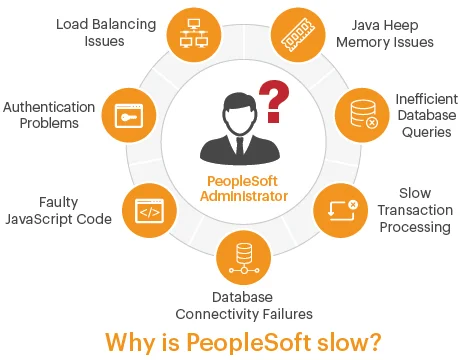
Firstly, PeopleSoft is critical to the business. Every minute of slowtime or downtime impacts business operations. Secondly, while multi-tier architectures are great for scalability, they are challenging to monitor and troubleshoot. Because there are dependencies between tiers, a problem in one tier – e.g., database slowness, can ripple and affect other tiers – e.g., the application server. IT administration and DevOps teams have a hard time determining where a root-cause of a problem lies. This is why organizations deploying PeopleSoft need to have proactive monitoring in place to alert them to issues and to assist with root-cause diagnosis.
What does PeopleSoft Monitoring Need to Cover?
Organizations deploying PeopleSoft need:
- To be able to monitor the experience of PeopleSoft users, so they know when users are experiencing slowness. Typically, a combination of synthetic monitoring and real-user monitoring approaches must be implemented.
- To troubleshoot issues, IT teams must have complete visibility into every layer and every tier of the PeopleSoft architecture. This includes the PeopleSoft application server, the database, the process scheduler, etc. Furthermore, the underlying infrastructure – whether virtualized or cloud-based must also be monitored.
- Analyzing metrics from all of the PeopleSoft tiers can be challenging. This is where AIOps capabilities can assist to highlight performance anomalies and highlight the root-cause of problems.
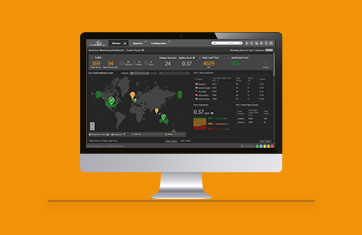
The eG Enterprise solution from eG Innovations has built-in expertise to monitor PeopleSoft deployments end-to-end. Customers across verticals have used our solution to monitor, diagnose, alert and report on PeopleSoft performance. To learn more about how eG Enterprise monitors PeopleSoft architectures, see: https://www.eginnovations.com/supported-technologies/peoplesoft-performance-monitoring
Frequently Asked Questions (FAQs)
PeopleSoft is an enterprise application suite used to manage critical business functions such as human resources, finance, payroll, procurement, supply chain, and student administration. Organizations rely on it to streamline operations, improve workforce management, automate business processes, and support data-driven decision-making across departments and locations.
The main PeopleSoft modules include Human Capital Management (HCM), Financial Management, Supply Chain Management (SCM), Customer Relationship Management (CRM), Enterprise Performance Management (EPM), and Campus Solutions. These modules help organizations manage employees, finances, purchasing, inventory, customer interactions, and academic operations through an integrated platform.
PeopleSoft uses a multi-tier architecture that separates the user interface, application processing, and database layers. Users access the system through a web browser, requests are processed by application servers, and data is stored in backend databases. This design improves scalability, performance, security, and manageability in enterprise environments.
Key PeopleSoft architecture components include the web server, PeopleSoft Internet Architecture (PIA), application server, process scheduler, integration broker, search framework, and database server. These components work together to handle user requests, execute business logic, process batch jobs, manage integrations, and store enterprise data efficiently.
PeopleSoft performance monitoring is essential for maintaining application responsiveness, ensuring business continuity, and delivering a positive user experience. Monitoring helps IT teams identify bottlenecks across web, application, and database tiers before they impact operations. eG Enterprise provides end-to-end visibility and root-cause analysis to accelerate issue resolution.
Common PeopleSoft performance issues include slow page loads, overloaded application servers, database bottlenecks, inefficient SQL queries, process scheduler delays, integration failures, memory constraints, and network latency. These problems can affect user productivity and business operations. eG Enterprise helps quickly detect, correlate, and diagnose the underlying causes of performance degradation.